Banks - All › Banks
How to Compare Banks Side by Side: A Worksheet Approach
Most bank comparisons fail before they start. They compare the wrong things: a headline savings rate against a sign-up bonus, a branch count against an app-store rating, one bank's best feature against another's worst. The result feels like research and behaves like advertising. A bank account is not a trophy purchase. It is a machine you run money through every week for years, and machines are compared on specifications — what they cost to run, what they pay you back, and how they behave when something goes wrong.
So put away the rankings. This guide gives you a worksheet instead: eight rows, filled in from documents the banks are legally required to give you, scored against how you actually bank. It takes about an hour for two banks. It will tell you more than a weekend of reading "best bank" lists, because those lists do not know that you deposit cash twice a month and run your balance down to $40 before payday. Your worksheet does.
Start with your habits, not their brochures
Before you look at a single bank, write down your last three months of banking. You need five numbers: your typical lowest balance before payday, how many cash withdrawals you make a month and where, whether you deposit cash, how many times in the past year a payment has hit an empty or nearly empty account, and how much you keep in savings on an ordinary day — not your best day.
These numbers decide everything that follows. A $12 monthly fee waived at a $1,500 minimum balance is free to someone who never drops below $2,000 and a $144-a-year tax on someone who drops to $300. An out-of-network ATM fee is irrelevant if you never use cash and decisive if you use an unfamiliar ATM twice a week. There is no "cheapest bank" — only the cheapest bank for a pattern of behavior, and the pattern is yours.
Row one: what the account costs to keep open
Ask each bank for two documents by name: the account opening disclosure and the fee schedule. Federal law requires banks to disclose the fees on a deposit account, and the FDIC's advice to shoppers is blunt — get the disclosure and the fee schedule and read them, rather than relying on a summary page. Everything in rows one through four comes from those documents.
Record the monthly maintenance fee and, just as carefully, the exact waiver. Bankrate's 2025 Checking Account and ATM Fee Study — a survey of hundreds of institutions — found that 47 percent of non-interest checking accounts charge no monthly fee at all. Among those that do charge, the average is $5.47 a month for non-interest checking. Interest-bearing checking is the trap in this row: it averaged a $15.65 monthly fee, and the average balance needed to avoid that fee was $10,705. An account that pays a sliver of interest while charging nearly $188 a year to anyone below five figures is not a premium product. For most households it is an expensive one, and the worksheet exposes it in one line.
Write the waiver as an action, not a hope: "waived with $500 in direct deposits" is testable against your pay stub. "Waived with a minimum balance" is testable against your lowest-balance number from the habits step. If you cannot meet the waiver in your worst month, score the fee as if you will pay it every month — because in your worst months, you will.
Row two: the cost of getting your own cash
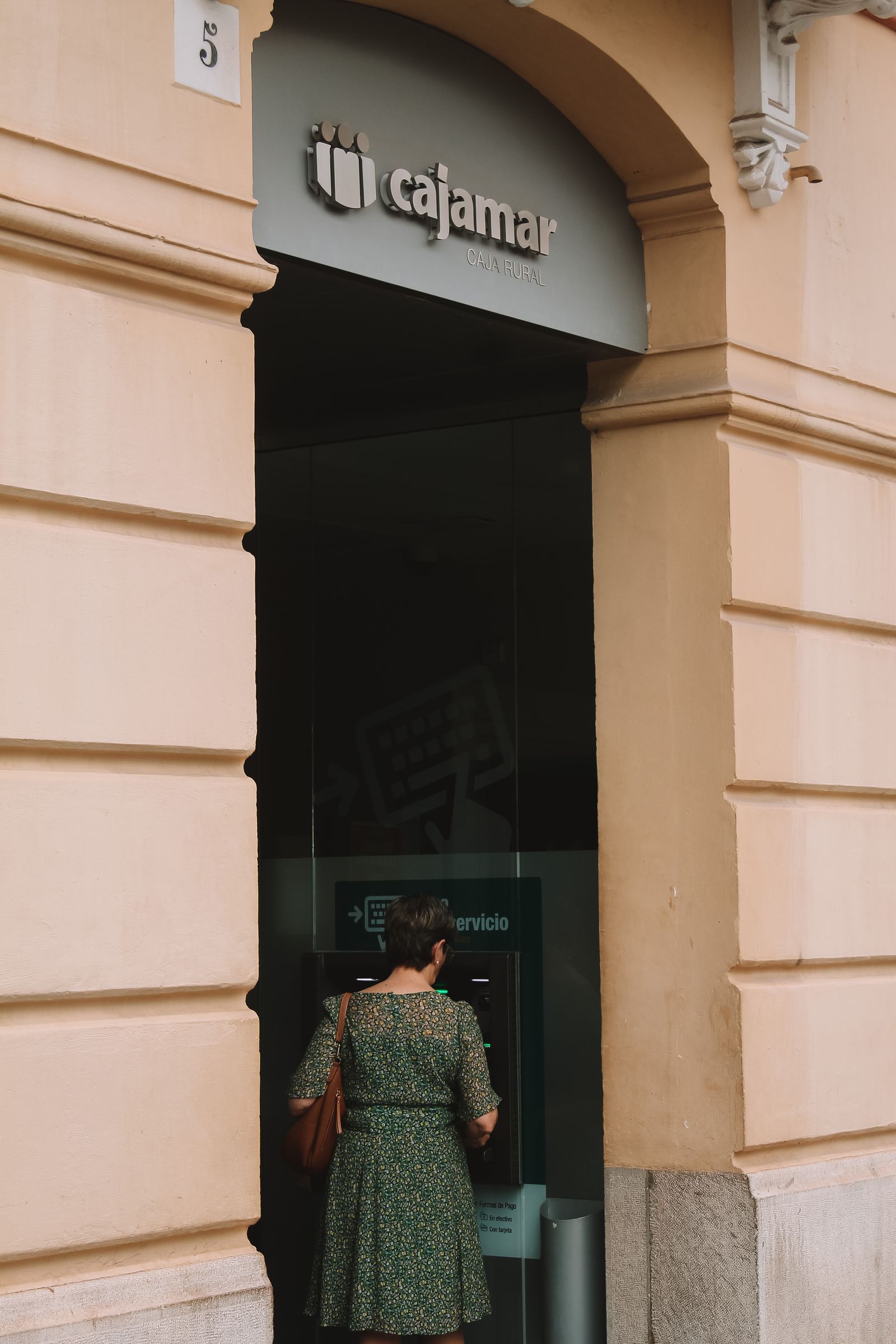
Note the size of the bank's own ATM network, whether it belongs to a shared network, whether it reimburses other banks' surcharges — and if so, up to how much a month — and what it charges when you stray. Bankrate put the average total cost of one out-of-network withdrawal in 2025 at $4.86, a record high, split between a $3.22 surcharge from the ATM's owner and $1.64 charged by your own bank. Two stray withdrawals a month is about $117 a year. That is more than many monthly fees, and it never appears in the advertising.
Branch access belongs in this row too, scored honestly. If you have not entered a branch in two years, 4,000 branches is a benefit you do not consume. If you deposit cash — tips, a side business, a market stall — the calculus reverses: many online banks make cash deposits awkward or charge for them through retail networks, and a local branch or credit union may win this row outright. This site's directory lists 7,521 locations under ATMs alone — a reminder that access is a map you draw around your own streets, not a national total.
Row three: overdrafts and the bad week
Every comparison needs a row for the week things go wrong, because that week is where bank accounts differ by hundreds of dollars. Record four things: the overdraft fee, whether the bank has eliminated it, any grace period or cushion amount before a fee applies, and the nonsufficient funds (NSF) fee charged when a payment is returned unpaid.
Bankrate's 2025 averages: an overdraft fee of $26.77, charged by 94 percent of accounts surveyed, and an NSF fee averaging $16.82. The FDIC notes that overdraft fees vary by bank and may run around $35 per transaction. Fees stack by transaction, so one bad morning with three small purchases can cost more than $80 at the average — and the federal rule that would have capped overdraft fees at $5 for the largest banks was overturned by Congress in May 2025, so the fee schedule in front of you, not a coming regulation, is what will govern your bad week.
One protection is yours to switch on or off. Under Regulation E, a bank cannot charge an overdraft fee on an ATM withdrawal or one-time debit-card purchase unless you have opted in to overdraft coverage; if you have not, the transaction is simply declined. Record each bank's policy and your own choice in the same box. For many households, "declined" is the cheapest overdraft program ever offered.
Row four: what your savings actually earn
Now the rate — deliberately fourth, because for most balances it matters less than the fees above it. Record the annual percentage yield (APY) on savings, and whether it is tiered, conditional, or a promotional rate that expires. Then do the arithmetic banks hope you skip: multiply the APY by the balance you actually keep.
The FDIC's national average rate on savings accounts was 0.39 percent APY in late 2025. On $5,000, that is about $19.50 a year. A high-yield account at 4.00 percent APY pays about $200 on the same balance — a real difference of roughly $180. But notice what the worksheet reveals: a single monthly fee of $15.65, paid all year on an interest checking account, costs $187.80, which wipes out the entire advantage of a top savings rate on a $5,000 balance. Rate-chasing while fee-bleeding is the most common error in bank shopping, and it survives because the rate is advertised in a font ten times larger than the fee. On $25,000 of savings, the order flips — the rate gap is worth about $900 a year and dominates the table. That is why the worksheet starts with your balance, not theirs.
| Worksheet row | Bank A | Bank B | Where to find it |
|---|---|---|---|
| Monthly fee and waiver | Fee schedule; account disclosure | ||
| Out-of-network ATM cost | Fee schedule; ATM network map | ||
| Overdraft fee, grace, NSF fee | Fee schedule; overdraft policy | ||
| Savings APY at your balance | Truth in Savings disclosure | ||
| Early-pay / direct deposit timing | Account terms; employer payroll | ||
| App: deposit limits, alerts, freeze | App store listing; terms | ||
| Support hours and human access | Bank website; test call | ||
| Insurance and charter | FDIC BankFind; NCUA Credit Union Locator |
Row five: speed — when money arrives and leaves
Two banks can hold the same balance and still feel completely different, because timing is a feature. Record when direct deposits are made available — some banks credit pay up to two days early, which is a genuine benefit if your bills cluster before payday — and how long the bank holds deposited checks, especially in the first 30 days of a new account, when holds are longest. Note mobile check-deposit limits — surprisingly low at some online banks — and external transfer limits and speeds in both directions. A bank that takes three business days and caps outbound transfers at a few thousand dollars is a poor home for money you may need to move quickly, however good its rate.
Row six: the app, tested rather than rated
App-store stars average together people rating a bank's logo and people rating a failed deposit. Test instead: before committing, check four tasks in the app — depositing a check, setting a low-balance alert, freezing a lost debit card, and finding a human from inside the app. Alerts deserve special weight: a low-balance alert is, in practice, an overdraft-prevention tool. If an app buries alerts or card controls, score it down; you will use those controls on the worst day, not the best one.

Row seven: a human when it matters
Score support on evidence: published phone hours, whether chat is staffed by people or deflected by a bot, and whether a local branch can resolve problems or only sell products. Then make one test call to each finalist with a real question from the fee schedule, and note whether the person who answered could explain the bank's own overdraft policy. This sounds like homework until the day your card is declined in another state; on that day, support is not a soft feature. It is the product.
Row eight: safety, and the bank-or-credit-union question
The last row is a pass/fail gate, not a score. Confirm the institution is federally insured: banks by the FDIC, credit unions by the NCUA, in each case generally up to $250,000 per depositor, per institution, for each account ownership category. Verify a bank in the FDIC's BankFind tool rather than trusting a logo on a website — look-alike banking sites exist, and an app that calls itself a bank may in fact be a technology company partnered with a bank, in which case the partner bank's name is the one that must appear in BankFind. If any part of that chain is unclear, stop. No APY compensates for ambiguity about who insures your money.
Credit unions belong on the worksheet, not in a separate mental category. They are member-owned, often beat banks on fees and loan rates, and are insured on the same terms — but membership is restricted by a field of membership (an employer, a place, a community), and their ATM and branch footprints are usually smaller, partly offset by shared-branching and ATM cooperatives. This site lists 1,384 credit-union locations in its largest credit-union category alongside 56,920 bank listings overall, which captures the real trade: the bank universe is vastly larger, so a credit union has to win on your worksheet rows — fees, rates, service — rather than on choice. Frequently, on those rows, it does.
Scoring it without fooling yourself
Total each bank in dollars, using your habits: twelve months of any fee you will actually pay, your expected ATM costs, one bad week of overdraft or NSF charges if your history says bad weeks happen, minus the interest your real balance earns. Then read the non-dollar rows — timing, app, support — and ask whether a dollar winner that fails them is really the winner. Usually the arithmetic and the judgment agree within a few dollars, and when they do not, trust the arithmetic for checking and the judgment for the bank you will call in a crisis.
Two closing rules. First, re-run the worksheet when your life changes — a job with cash tips, a move, a savings balance crossing five figures — not when an advertisement tells you to. Second, keep the losing worksheet: banks change fee schedules with written notice, and comparing the new schedule against the old worksheet takes ten minutes and stops the slow drift into an account that no longer fits.
Sources
- Bankrate, 2025 Checking Account and ATM Fee Study — monthly fee averages ($5.47 non-interest, $15.65 interest checking), the $10,705 average balance to waive the interest-checking fee, the $26.77 average overdraft fee charged by 94% of accounts, the $16.82 average NSF fee, and the $4.86 average total cost of an out-of-network ATM withdrawal.
- Federal Deposit Insurance Corporation (FDIC), "Overdraft and Account Fees" — banks must disclose deposit account fees in the account opening disclosure and fee schedule; overdraft fees vary by bank and may cost around $35 per transaction; monthly fees may be waived for direct deposit, a minimum balance, or a set number of transactions.
- Federal Deposit Insurance Corporation (FDIC), national average rates — the national average savings account rate of 0.39% APY in late 2025, as reported from FDIC data.
- Consumer Financial Protection Bureau (CFPB) and Regulation E — a bank may not charge an overdraft fee on ATM or one-time debit-card transactions unless the customer has opted in; the CFPB's December 2024 rule capping overdraft fees at $5 for very large banks was overturned by Congress in May 2025.
- Federal Deposit Insurance Corporation (FDIC), BankFind Suite, and National Credit Union Administration (NCUA) — deposit insurance of $250,000 per depositor, per insured institution, per ownership category, and the official tools for verifying an institution's insured status.
- Photos: Woman at an ATM outside a bank — photo by Sofía Marquet, https://www.pexels.com/photo/woman-using-atm-17166809/ ; Two people at touchscreen terminals in a modern bank — photo by Darlene Alderson, https://www.pexels.com/photo/4383384/ ; Bank building engraved on a banknote — photo by Karola G, https://www.pexels.com/photo/image-of-old-building-on-american-banknote-4386157/